 Beatrice
Your website has a finite number of pages, but the number of ways you can connect them is nearly infinite. SEO professionals often debate the relative importance of internal versus external linking, yet few acknowledge a more critical truth: they are not competing tactics but complementary systems with different operating instructions. Getting the balance wrong can cap your site's potential or even work against your rankings. This article clarifies the distinct roles each link type plays in a modern search strategy.
You will learn the specific ranking signals each system feeds to Google, how they influence user behavior differently, and where most in-house teams make costly structural errors. We will map out actionable frameworks for auditing and planning both your internal silo structures and your external relationship portfolio. The goal is to equip you with a practitioner's perspective, moving beyond theory to the patterns that surface in real website audits.
The primary objective: why search engines treat internal and external links differently
Imagine a librarian organizing a vast collection. Internal links are the meticulously labeled cards in the library's own catalog system, showing how topics relate within the building. External links are citations and references in published academic papers, pointing to authoritative works in other libraries worldwide. Google's algorithms are designed to evaluate both systems, but they look for different things in each.
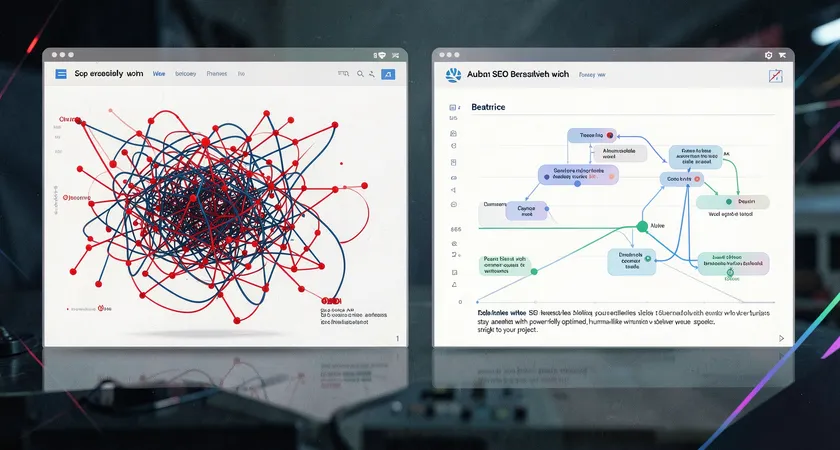
Internal linking is primarily an architectural and contextual signal. It tells search engines how you have organized your content, which pages you consider most important (through link equity flow), and how deeply you cover a topic cluster. A well-linked page deep within your site becomes easier for Google's crawler to discover and contextualize. In contrast, external links are a credibility and relevance signal from the wider web. A link from a highly-trusted site to your page acts like a vote of confidence, suggesting your content is a credible source on that topic. The key distinction is control: you have absolute control over your internal link graph, but only influence over your external one.
This fundamental difference dictates strategy. Internal linking is a continuous, iterative process of optimization you conduct on your own property. External linking is often a byproduct of creating exceptionally useful or noteworthy content that others want to reference. Confusing these goals leads to wasted effort, like spending months on a rigorous internal linking pass while publishing thin content that will never attract a single authoritative backlink.

Strategic internal linking: building a navigable fortress of content
Start with a single product page for a premium coffee grinder. Without internal links, it's an isolated island. With strategic linking, it becomes the hub of a topic cluster. You link it to your guide on grind size, your article on burr versus blade mechanics, and your comparison page of top home grinders. This creates a thematic silo that signals to Google your extensive authority on coffee grinders. The link equity from your strong home page and category pages flows to this cluster, boosting its collective ranking potential.
The most effective internal links are contextual and helpful. They appear naturally within the body content, guiding a user to a more detailed explanation or a logical next step. Common pitfalls include over-relying on navigational footers or sidebars with generic "related posts" modules, which pass equity but lack strong topical relevance. Another frequent mistake is creating circular or shallow links that don't push users toward conversion or deeper engagement.
Auditing your existing internal link structure
You cannot improve what you don't measure. A basic audit starts with a crawl tool like Screaming Frog or Sitebulb. Look for orphaned pages (pages with no internal links pointing to them), pages with an excessively high number of outbound links which can dilute equity, and important commercial or informational pages that receive surprisingly little internal link equity. The goal is not to create a perfectly symmetrical graph, but to ensure your most valuable pages are well-connected within their topical neighborhoods.
On the ground, we often see that blog content exists in a separate silo from commercial or service pages. This is a missed opportunity. A well-researched blog post about "signs you need a new roof" should contextually link to your service page for roof inspection or replacement. This guides the user and transfers topical relevance and authority to your money pages.
Strategic external linking: cultivating a web of credibility
Consider a financial advisor writing a comprehensive guide on retirement planning. Citing and linking to official IRS publications, authoritative studies from reputable institutions, and well-regarded economic news outlets does several things. It builds trust with the reader by showing due diligence. It provides genuine value. And it signals to search engines that your content is well-researched and situated within the broader, trustworthy ecosystem of information on that topic.
The outdated practice of "link building" often focused on quantity. The modern practice of earning links is about quality and relevance. The strategic value of an external link is not just in the link itself, but in the referral traffic and brand association it can bring. A single link from a niche industry publication to your deep technical review can be more valuable than dozens of low-quality directory links.

The double-edged sword of outbound links
A persistent myth suggests that linking out to other sites "leaks" PageRank. This is not strategically sound. Linking to high-quality, relevant sources is a user experience and E-E-A-T (Experience, Expertise, Authoritativeness, Trustworthiness) positive. It shows you've done your homework. However, linking to spammy, irrelevant, or untrustworthy sites can harm your site's perceived quality. The rule is simple: if you wouldn't personally recommend the source to a client, don't link to it. Be judicious, but not fearful, of outbound links.
Common traps and costly misapplications
One of the most frequent errors we see in audits is the over-optimization of anchor text. For internal links, using the exact-match commercial keyword for every link to a product page (e.g., "best coffee grinder") appears manipulative. A natural profile includes variations like "this burr grinder," "our full review," or "check pricing here." For external links, the trap is linking to a source solely because it has high Domain Authority, even if its content is tangentially related at best. This creates a poor user experience and a weak topical signal.
Another trap is scale. On a small site with fifty pages, managing internal links manually is feasible. On an enterprise site with thousands of product SKUs, blog posts, and help articles, manual linking becomes impossible. Teams often resort to rigid, automated rules that create a bloated, irrelevant link graph. Similarly, earning external links at scale requires a systematic approach to content creation and digital PR that many marketing teams are not structured to execute.
When to manage in-house and when to seek structured support
The foundational principles of linking are straightforward. Any competent SEO or content manager can implement a basic internal linking pass and establish guidelines for citing external sources. The DIY approach works well for establishing initial site architecture, cleaning up critical orphaned pages, and setting a content standard that naturally attracts some external links. This phase is about getting the basics right and avoiding glaring errors.
The complexity escalates with growth. When your content repository scales into the thousands of pages, the internal link graph becomes a living system that needs ongoing analysis and optimization. Identifying broken links is easy; identifying equity sinks, missed topical connections, and opportunities to reinforce new content clusters requires dedicated tools and analysis time. For external linking, moving from a passive "earn what you get" stance to an active strategy that generates qualified backlinks consistently is a full-time specialty. It involves content ideation that fills market gaps, outreach, and relationship building.
This is the point where the operational lift often exceeds the capacity of a generalist marketing team. The work shifts from tactical implementation to strategic architecture and systematic execution. An expert partner brings not just labor, but a methodology and toolset for diagnosing link graph health, prioritizing fixes that move the needle, and executing linkable asset campaigns with a measurable return. The value isn't in doing the easy tasks, but in navigating the complexity that emerges after those tasks are complete.

The integrated workflow: making both systems work in concert
Your linking strategy should not live in a spreadsheet. It should be integrated into your content planning and publishing workflow. The process begins at the content brief stage. When a new article is planned, the brief should include a section for target internal link destinations (which existing pillar pages or commercial pages will this link to?) and a section for potential external sources to reference. This bakes linking intent into the content from the start.
Upon publication, a standard operating procedure should trigger. The new piece is reviewed for potential links from older, relevant content (a process sometimes called "reverse internal linking"). It is also added to relevant hub or category pages. For external link acquisition, the published piece becomes an asset for your outreach efforts. This closed-loop system ensures linking is proactive, not an afterthought. The biggest ranking wins typically come from sites that execute this integrated workflow consistently, treating their link graph as a core business asset that requires ongoing investment and care.
The debate between internal and external linking is a false dichotomy. A robust SEO strategy requires a strong, well-organized internal architecture to be fully legible to search engines, and a credible external link profile to validate that authority in the eyes of the wider web. Neglecting one for the other leaves a critical gap in your site's foundational signals.
Begin by conducting a technical audit of your current internal link equity distribution and the quality of your outbound references. This will reveal immediate opportunities for improvement. Then, integrate linking considerations into your editorial calendar, making it a standard part of the content lifecycle. For organizations where content volume and complexity have grown, the next step is often seeking a partner with the specialized tools and methodologies to manage the link graph as a dynamic system. The goal is not just to have links, but to have a purposeful structure that guides both users and search engines to your most valuable content, reinforced by the trust signals that only the broader web can provide.