 Beatrice
You have a great topic and solid information, but your article isn't ranking. The text might be useful, but its structure makes it invisible to search engines and frustrating for users. The architecture of your content is not just about formatting; it's a direct signal to Google about your article's relevance and authority on a topic. A poor structure spreads your topical relevance thin, confuses search intent, and leads to high bounce rates. This guide moves beyond basic SEO advice to focus on the tactical, often overlooked art of content structuring. You will learn how to systematically build an article from the search query up, how to signal depth and expertise through your organization, and how to avoid common structural pitfalls that kill visibility before your first click.
Start with the search query, not the conclusion
Many writers begin an article by outlining what they want to say. For search visibility, this is backwards. Your primary structuring tool is the search query itself, which reveals a specific user intent. An article titled "Best running shoes for flat feet 2024" has a different goal than one titled "How to treat plantar fasciitis from running." The first is commercial-transactional; the user is likely comparing products. The second is informational; the user wants a solution to a problem. If you structure the informational article like a buyer's guide, you will fail to rank because you missed the intent.
Your first task is to deconstruct the primary keyword. Type it into Google and analyze the top five organic results. Look beyond the keywords they use. Look at their structure. What are the main H2 headings in those articles? What questions do they answer in the FAQ or People Also Ask section? This analysis gives you a blueprint for the content architecture Google currently rewards for that query. It tells you what subtopics are considered essential and what depth is required. You are not copying them; you are reverse-engineering the structural expectations for that specific search.
For a query like "structuring articles for search visibility," the top results consistently cover intent mapping, heading hierarchy, and semantic depth. This tells you these are non-negotiable structural pillars for your own article. Ignoring them tells Google your content is incomplete.

Mapping user intent to your content outline
Once you understand the core intent, map out the user's likely journey. A user searching for "Python logging best practices" is probably a developer who has a basic logger but is hitting issues with scale or debugging. Their journey starts with configuration, moves to formatting and handlers, then to performance for high-volume applications, and finally to advanced tools like structured logging. Your article structure should follow this logical, escalating path of complexity. Each H2 becomes a milestone in their learning journey.
This intent-driven outline serves a dual purpose. For the user, it provides a clear, logical progression that builds their understanding. For Google, it creates a rich, well-organized semantic field. When Google's bots crawl your page, they encounter a coherent topic cluster built around the main query, with clear signals about how each subsection relates to the whole. This makes it far easier for algorithms to understand your content's expertise and assign it to the right search results.
Architect your heading hierarchy for both bots and readers
Headings are the skeleton of your article. A weak skeleton collapses under its own weight. The H1 is the title, set by the page. Your H2s are the major structural beams. In practice, we see that articles ranking for competitive queries almost always use H2s to break the topic into 4 to 7 distinct, substantive sections. Each H2 should represent a complete sub-answer to the main query. Think of them as mini-articles within the whole.
A common mistake is using H2s as decorative labels or section breaks with little content. An H2 titled "The Importance of Structure" followed by two vague paragraphs is a wasted opportunity. Instead, make it specific and action-oriented: "How a Clear H2 Hierarchy Lowers Bounce Rates." This directly targets a user concern (high bounce rates) and promises a specific insight. The content under it must then deliver a causal explanation, perhaps referencing page speed metrics or user eye-tracking patterns, without needing to cite a specific proprietary study.

The role of H3s in deepening topic coverage
H3 tags are your supporting joists. They exist to elaborate on the point made in the H2 above them. If your H2 is about optimizing images for SEO, relevant H3s might be "Choosing the Right File Format (WebP vs. JPEG vs. PNG)," "Implementing Responsive Images with srcset," and "Lazy Loading for Below-the-Fold Content." Each H3 drills down into a technical or conceptual nuance.
This H2/H3 nesting is a powerful depth signal. It shows search engines that you are not just skimming the surface of a topic but exploring its facets in detail. From a practical standpoint, it also enhances readability. Large blocks of text under a single H2 are intimidating. Breaking them up with descriptive H3s gives readers natural pause points and improves scanability, which keeps them on the page longer.
Use semantic structure to build topical authority
Beyond headings, the internal linking of ideas within your prose builds what SEOs call "topical authority." This means Google views your site as a comprehensive, trustworthy source on a given subject. Structure is key here. It's not about keyword density; it's about concept density.
Take the core concept of "search visibility." A structurally sound article will naturally weave in related entities and concepts throughout its sections: crawl budget, indexation, SERP features (like featured snippets or people also ask), click-through rate, user engagement signals, and E-E-A-T (Expertise, Experience, Authoritativeness, Trustworthiness). These aren't forced keywords; they are the natural vocabulary of a deep discussion on the topic. Your article's structure should provide a logical place for each of these concepts to be introduced and explained in relation to the whole.
For instance, a section on heading hierarchy can naturally lead to a discussion of how clear structure improves user experience, which is a known engagement signal. This connects two concepts (structure and UX) in a way that is helpful for the reader and semantically rich for search engines.

The paragraph as a unit of thought
Even at the micro-level, structure matters. A well-structured paragraph presents one clear idea, supported by 2-4 sentences. The first sentence often introduces the concept. The following sentences explain, exemplify, or justify it. The final sentence may transition to the next idea. This predictable internal logic makes your content easier to parse for both humans and machines.
Contrast this with a common flaw: the rambling paragraph. It starts on one point, digresses to another, and ends somewhere unrelated. This scatters your semantic signals and confuses the narrative thread. In audits, we frequently see that pages with lower rankings also have poorer paragraph cohesion. The fix is disciplined editing. Read each paragraph aloud. Does it have a single, defensible point? If not, split it or tighten the focus.
Practical signals of depth and comprehensive coverage
Search engines use heuristic signals to guess if an article is superficial or deep. Length is one rough proxy, but structure provides more nuanced signals. Certain structural elements act as flags for comprehensive content.
A dedicated FAQ section, especially one that pulls from Google's own "People Also Ask" data, is a strong signal. It shows you are anticipating related queries and providing direct answers. This keeps users on your site and satisfies a broader range of search intents. Similarly, a clear introduction that frames the problem and a conclusion that synthesizes key takeaways (without simply repeating them) bookends your content, framing it as a complete resource.
Lists and tables, when used appropriately, are another structural signal of organized, digestible information. A comparison table of tools or a step-by-step numbered list for a process indicates you are providing utility, not just commentary. However, as noted earlier, these should be used sparingly and substantively. A list of three one-word items is noise. A list of five detailed steps is value.

Common structural pitfalls that sabotage SEO efforts
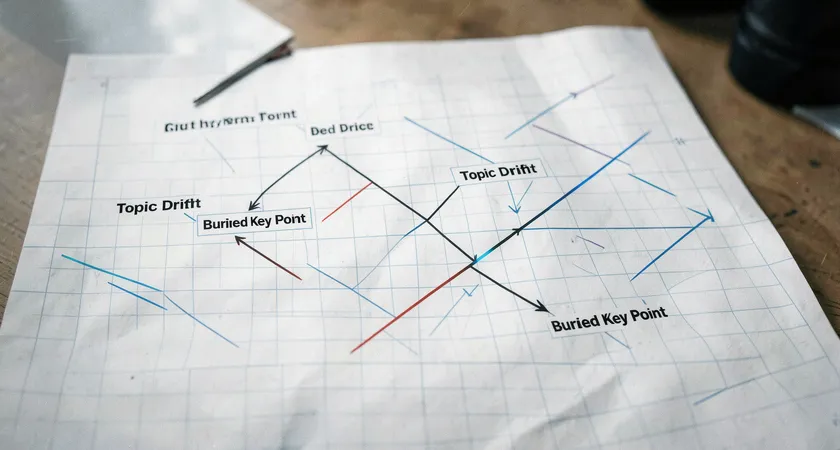
Many visibility issues stem from avoidable structural errors. The first is the "hidden content" problem. Critical information is buried in long paragraphs or placed below intrusive interstitials, making it hard for bots and users to find. If your key solution is 1500 words down in a dense block, many will never reach it.
The second pitfall is the "topic drift." An article starts strong on its target keyword but then meanders into a tangentially related area. For example, an article on "structuring articles" might suddenly launch into a deep dive on keyword research tools for two paragraphs. This dilutes the primary topic's focus. While related concepts are good, they should be clearly subservient to the main thread.
A third, subtler pitfall is the "assumed knowledge" structure. The article jumps into advanced terminology or steps without laying the foundational concepts. This structure appeals to a tiny expert audience but fails the majority of searchers who need the basics explained first. It results in high bounce rates as users leave to find a more beginner-friendly guide. The fix is to structure your article to teach, assuming the reader starts with curiosity, not expertise.
When DIY structure hits its limits
For a single blog post, a focused writer can apply these principles successfully. The challenge scales with the content volume and the complexity of the topic cluster. Maintaining consistent, intent-optimized structure across 50 or 500 articles is a massive operational task. It requires not just writing skill but systematic planning, constant reference to SERP evolution, and an editorial process that enforces structural rules.
This is where purely manual processes break down. Inconsistencies creep in. Some articles get deep, comprehensive structures while others remain shallow. The semantic field across a site becomes patchy rather than cohesive. Keeping the heading hierarchy logical and the semantic depth strong across an entire content library becomes a full-time job of auditing and rewriting. Many marketing teams simply lack the bandwidth or specialized SEO content expertise to do this at scale, leading to a portfolio where only a fraction of content realizes its full visibility potential.
Conclusion
Article structure is the invisible framework that determines search visibility. It begins with a ruthless analysis of search intent and competitor blueprints, translates into a logical heading hierarchy that guides users and bots, and is solidified through semantic richness and signals of depth. The difference between an article that ranks and one that languishes often comes down to this disciplined architectural approach. Your immediate next step should be to audit your top-performing piece and your most underperforming piece side-by-side. Compare their structures using the principles here. The gaps you find will provide a clear roadmap for improvement. For organizations publishing at scale, this structural rigor is the baseline for competing in crowded search landscapes, often necessitating tools or expert oversight to maintain consistency and depth across every piece published.