 Beatrice
Your developer sends a Slack message: "The production blog feed is showing draft posts again." You ask which endpoint they used. The answer is a shrug and a link to a four-year-old Postman collection. This familiar friction is often rooted in one overlooked asset: the state of your content endpoints' documentation. When your content delivery depends on APIs, the quality of your API documentation directly impacts the quality, consistency, and velocity of your content operations. To go deeper, you can also read Benefits of Fully Documented Content Endpoints: Unlocking Efficiency and Growth.
For teams scaling SEO through automated or headless content systems, content endpoints are the critical pipelines. A fully documented endpoint isn't just a technical nicety; it's a strategic enabler for marketers, developers, and content strategists alike. It turns a black-box API call into a reliable, understandable, and scalable component of your workflow. This article examines the concrete, often underestimated benefits of investing in comprehensive documentation for these endpoints, moving beyond the generic "good practice" to show how it tangibly affects development speed, team collaboration, content integrity, and long-term system health. We'll also address the common pitfalls teams encounter when documentation is an afterthought, and what it takes to maintain it as a living resource. To go deeper, you can also read Managing categories in content-heavy projects.
From days to hours: how documentation accelerates development and integration
Consider a new developer joining a project to build a new "Featured Articles" component for the homepage. They need to fetch articles tagged as "featured," with specific fields like title, excerpt, image URL, and publication date. Without documentation, they start a detective hunt: inspecting network calls, digging through GitHub repos for example code, or interrupting senior developers. This initial investigation can consume the better part of a day.
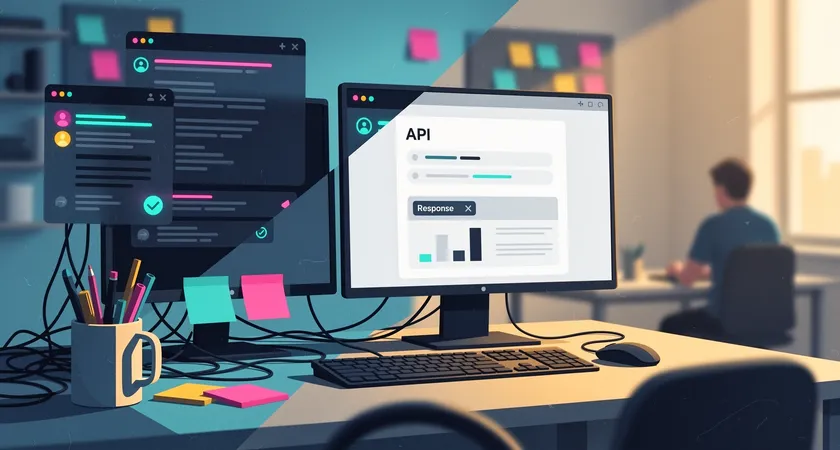
Now picture the same developer with access to a dedicated, well-organized documentation portal for the content API. They find a clear section for the /articles endpoint. It lists available query parameters, including ?filter[tag]=featured. The response schema is shown with sample JSON, explicitly marking which fields are always present and which are optional. There's a live, interactive console where they can test the call with their own API key. What was a day of friction is reduced to an hour of focused work. The velocity gain is not hypothetical; it's a consistent pattern observed across integration projects. Documentation effectively transfers knowledge without human intermediation, removing a major bottleneck.
This acceleration extends far beyond initial onboarding. Third-party integrations, like connecting your content repository to a CRM for personalized email campaigns or to a data visualization tool, become dramatically simpler. External contractors can work autonomously. The reduction in back-and-forth clarification emails and support tickets alone represents a significant return on the initial documentation investment.
Eliminating guesswork with precise parameter and schema definition
Poor documentation often manifests in vague descriptions. A parameter listed simply as "date" leaves the developer guessing: Is it a publication date, a last-modified date, an ISO string, or a Unix timestamp? A field described as "image" could be a URL string, an object with multiple size variants, or a base64-encoded blob. This ambiguity leads directly to bugs. The homepage component might break because it receives an object where it expected a string.
Fully documented endpoints specify data types rigorously: string, integer, boolean, ISO 8601 datetime. They detail nested object structures. More importantly, they explain intent. For instance, documentation might state: "Use the fields parameter to limit the response to only the data you need, improving request performance. For the articles endpoint, available root-level fields are: id, title, excerpt, content, featured_image..." This turns the API from a mysterious data source into a predictable tool.
Building a shared language between technical and non-technical teams
A content manager needs to confirm if the system can automatically pull a list of the latest case studies sorted by a custom "priority" field for a new landing page. In an undocumented environment, they must ask a developer, who may need to read the actual code or test the API to find out. This creates a dependency loop that slows down planning and erodes team autonomy.
Comprehensive documentation acts as a shared source of truth. When endpoints are documented with clear language alongside the technical specs, non-technical stakeholders can explore capabilities independently. A well-designed doc site might have a plain-language overview: "To get content for the resources page, we have two primary endpoints. The /case-studies endpoint returns all published case studies, and you can filter them by industry or product line using the parameters listed below." This empowers product managers, SEO strategists, and content leads to participate in architectural discussions, plan new features, and verify requirements without constant translation.
This shared understanding reduces misalignment. When the marketing team requests "a feed of articles filtered by author," the developer can point to the existing ?filter[author_slug]= parameter in the docs. The request moves from a vague "build something" to a precise "utilize this existing capability." The conversation shifts from feasibility to implementation, which is a far more efficient dynamic for any growing organization.
Fostering collaboration and reducing silos
Silos form when information is inaccessible. If only the original backend developer knows the intricacies of the content pagination system, that knowledge becomes a risk. Documentation breaks down these silos by institutionalizing knowledge. Frontend developers, DevOps engineers, and even new hires can understand how the content flows, where potential failure points are (like rate limits or cache headers noted in the docs), and how to use the system correctly.
The result is a more resilient and collaborative team. Onboarding is faster. Cross-functional projects, like implementing server-side rendering for SEO where content is fetched at build time, progress more smoothly because everyone is reading from the same page, literally. The documentation becomes the neutral ground where technical decisions are recorded and explained, fostering a culture of clarity over obscurity.

Ensuring content consistency and safeguarding against regressions
A common and frustrating bug in content-driven applications is the silent regression. A website's article cards suddenly show raw HTML tags because the `excerpt` field, which previously contained plain text, now returns the full HTML content. This often happens after a backend update where the contract between the API and its consumers changes unintentionally. Without documentation that serves as an explicit contract, these breaking changes are easy to introduce and hard to catch before they reach users.
Thorough endpoint documentation defines this contract. It states unequivocally: "The `excerpt` field is a plain-text string, max 160 characters, with all HTML tags stripped." When a developer modifies the backend logic to populate this field, they are reminded of this contract. Good documentation practices are often integrated with change management; some teams even tie their documentation to their API tests, ensuring that any change that breaks the documented behavior fails the test suite.
This protective function is crucial for maintaining content integrity, which is the bedrock of good SEO and user experience. It ensures that meta descriptions pulled via API are the correct length, that image URLs are properly formatted, and that required fields are never null. It turns the API from a potential source of instability into a pillar of reliability.
Documentation as a living audit trail
Over time, documentation accumulates historical context that is invaluable. Notes in a changelog section might explain: "As of v1.2.0, the `published_at` field now returns a UTC timestamp instead of local time." Or: "The `featured_image` object now includes a `srcSet` attribute for responsive images." This audit trail answers the "why" behind the current behavior, helping teams understand dependencies and make informed decisions about updates or migrations. It prevents the classic scenario of a team spending days debugging an issue only to discover it was a deliberate, albeit poorly communicated, change made months prior.

Mitigating technical debt and future-proofing your content architecture
Technical debt accrues silently in content systems. A team builds a quick integration by hardcoding an endpoint URL and a specific field mapping. Two years later, that endpoint is deprecated, but six different services and two client websites depend on its exact behavior. The cost of untangling this web is high. This scenario is less likely when documentation is treated as a core part of the API lifecycle.
Proper documentation includes clear deprecation policies and versioning strategies. It signals the future path. For example, an endpoint doc might include a warning banner: "This v1 endpoint is deprecated. Please migrate to v2 by Q4 2024. V2 uses a more consistent filtering syntax and improves performance." This gives consuming teams ample time and clear direction for migration, turning a potentially chaotic breaking change into a managed transition.
Furthermore, the act of documenting forces a valuable discipline. It requires developers to think about their API design from the consumer's perspective. This often surfaces design flaws early, inconsistent naming, overly complex responses, missing filters, that would otherwise become entrenched as technical debt. In this way, documentation isn't just describing the system; it's actively guiding it toward a cleaner, more sustainable architecture.
The hidden costs of "good enough" documentation
Many teams start with a basic OpenAPI spec generated from code comments or a hastily written README file. This "good enough" approach works until it doesn't. The hidden costs emerge gradually: increased support burden for the core platform team, slower feature development due to constant clarification duties, and a higher error rate in integrations. More insidiously, it leads to a fear of changing the API, stagnating innovation because the cost of communicating changes seems too high.
Investing in full documentation, with overviews, authentication guides, detailed examples, error code explanations, and a maintained changelog, pays down this debt upfront. It creates a platform that can scale with your content ambitions, whether that's serving content to a new mobile app, syndicating to partners, or powering a complex multi-regional site structure.

Navigating the implementation: common pitfalls and maintenance realities
The benefits are clear, but the path to achieving and maintaining fully documented endpoints is where many projects stumble. The initial enthusiasm to document everything often collides with sprint deadlines and shifting priorities. A common pitfall is creating beautiful, comprehensive documentation at launch that rapidly becomes outdated after the first few code updates. Outdated documentation can be worse than none at all, as it actively misleads and causes errors.
Sustaining documentation requires process. It needs to be woven into the development workflow. This often means treating the documentation source files as code, storing them in the same repository, and requiring updates as part of the definition of done for any API-related task. Some teams use automated tools to generate reference documentation from code annotations, but they complement this with hand-written guides and examples that explain the "why" and provide context that code alone cannot.
Another frequent challenge is ownership. Is documentation the developer's job, a technical writer's, a product manager's? Without clear ownership, it falls through the cracks. Successful teams often assign a primary maintainer for the docs and make everyone a contributor, establishing simple standards for clarity and completeness. They also integrate documentation reviews into their API design review process, ensuring it's considered from the start, not added as an afterthought.

When expertise matters: bridging the gap between concept and reliable system
Understanding the value of documentation is one thing; implementing a robust, scalable, and maintainable documentation system is another. It involves choices about tooling (OpenAPI, Markdown, dedicated platforms), integration with CI/CD pipelines for auto-deployment, and designing for both technical and non-technical audiences. For teams deeply focused on their core product, this can represent a significant diversion of focus and resources.
This is where the strategic advantage of specialized partners becomes evident. Teams that work with providers for whom API design and documentation are core competencies can bypass the learning curve and operational overhead. They gain access to systems where documentation is not a separate chore but an inherent, automated output of the platform itself, always accurate, always up-to-date, and designed for consumption. This allows internal teams to concentrate on leveraging the content endpoints to drive SEO and business value, rather than on maintaining the plumbing. The difference is between building and managing the entire content delivery infrastructure versus plugging into a reliable, well-documented engine that scales with your needs.
In practice, the choice often hinges on a simple question: is content API infrastructure your product, or is it a means to an end for your content and SEO goals? For many, the efficiency gained from a dedicated, expertly maintained system outweighs the perceived control of a DIY approach, especially when consistency, reliability, and velocity are critical to content success.
The return on investing in fully documented content endpoints is measured not in abstract principles but in tangible outcomes: faster time-to-market for new features, fewer production bugs, empowered cross-functional teams, and a content delivery layer that acts as a solid foundation rather than a source of constant firefighting. It transforms your content API from a technical implementation detail into a strategic asset that anyone on your team can understand, trust, and use effectively. The initial effort pays continuous dividends in clarity, speed, and stability, enabling you to scale your content ambitions without being hamstrung by the underlying technology.